
Complemento alimenticio, Cosmética, Salud y Bienestar
Melatonina: más allá del sueño. Qué es, para qué sirve y cómo elegirla bien
Nov
Melatonina: más allá del sueño. Qué es, para qué sirve y cómo elegirla bien
Introducción. La melatonina es una hormona esencial en el equilibrio del organismo. Regula los ciclos del sueño y la vigilia, ejerce una potente acción antioxidante y también está presente en la piel, donde cumple funciones protectoras frente al estrés oxidativo y la radiación. En este artículo se explica qué es, cómo se sintetiza, qué funciones desempeña, cuándo puede ser útil su suplementación y cómo elegir un complemento de calidad. También se revisa la legislación vigente y los “claims” autorizados por la EFSA.
1. ¿Qué es la melatonina?
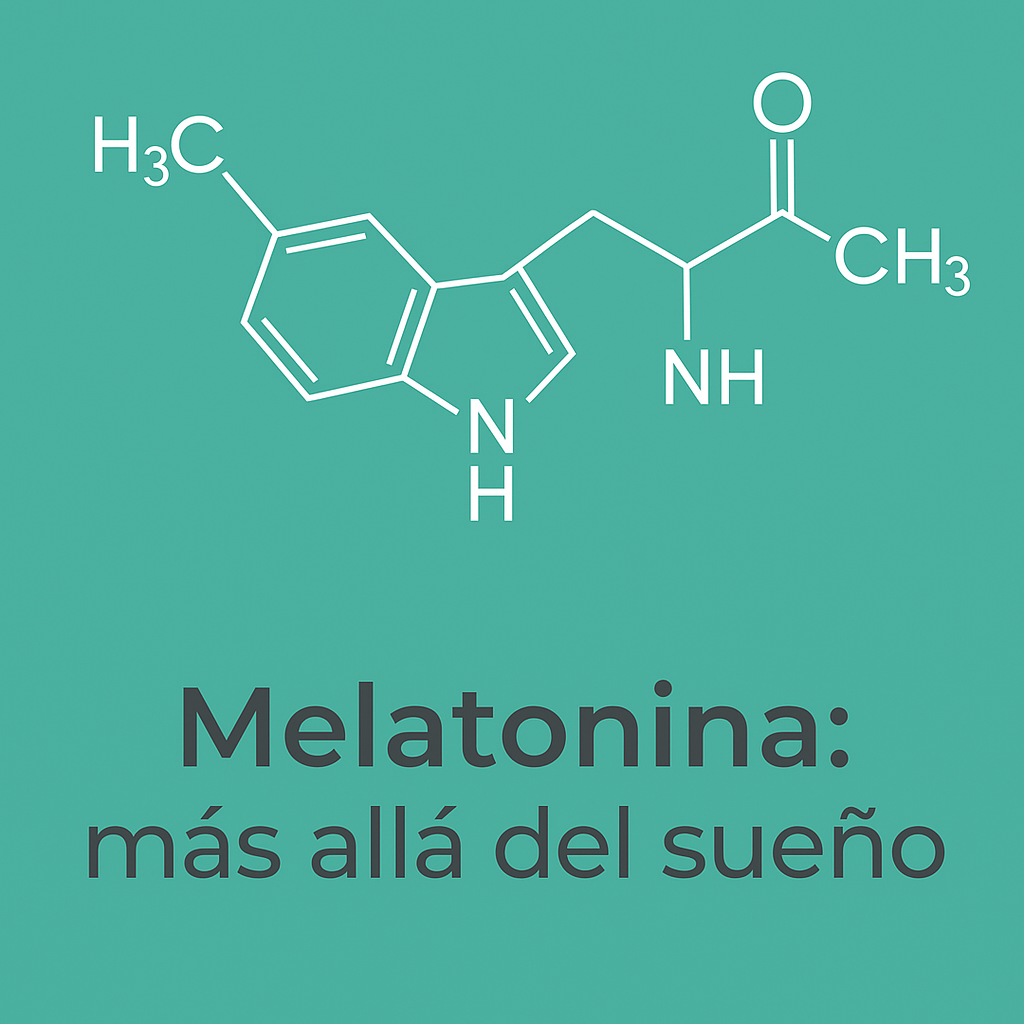
La melatonina (N-acetil-5-metoxitriptamina) es una hormona natural sintetizada principalmente en la glándula pineal a partir del aminoácido esencial triptófano, a través de la serotonina. Su producción aumenta con la oscuridad y disminuye con la luz, por lo que actúa como un regulador del ritmo circadiano, indicando al organismo cuándo debe dormir y cuándo permanecer despierto.
2. Dónde y cómo se sintetiza
Aunque la glándula pineal es la principal fuente, la melatonina también se produce en otros tejidos: piel, retina, médula ósea, intestino, hígado y células inmunitarias, entre otros. En estos lugares se comporta como una molécula autócrina y paracrina, actuando localmente como antioxidante y modulador de la inflamación. Esta síntesis “extrapineal” no depende de la luz y contribuye al equilibrio celular.
3. Funciones principales en el organismo
- Regulación del sueño y ritmos circadianos: favorece la conciliación del sueño y la estabilidad del ciclo sueño-vigilia.
- Acción antioxidante y mitocondrial: neutraliza radicales libres y estimula enzimas protectoras como superóxido dismutasa, catalasa y glutatión peroxidasa.
- Protección neuronal: interviene en la plasticidad sináptica y la función cognitiva.
- Inmunomodulación: regula la secreción de citoquinas y modula la respuesta inmunitaria.
4. Qué ocurre cuando hay un déficit de melatonina
La disminución de su producción, ya sea por envejecimiento, exposición prolongada a luz artificial nocturna o estrés, puede provocar:
- Dificultad para conciliar el sueño o insomnio.
- Desajustes del ritmo circadiano (jet lag o trabajo nocturno).
- Fatiga, menor rendimiento y somnolencia diurna.
- Aumento del estrés oxidativo y aceleración del envejecimiento celular.
- Cambios en el estado de ánimo o en la regulación inmunitaria.
En las personas mayores, la síntesis endógena se reduce de manera significativa, lo que puede justificar el uso de suplementos bajo consejo profesional.
5. Melatonina y piel: la conexión cutánea
La piel dispone de su propio sistema de melatonina, capaz de producirla y metabolizarla. En este contexto, actúa como antioxidante, antiinflamatoria y fotoprotectora, ayudando a reparar el daño causado por la radiación ultravioleta y la luz visible. Se ha estudiado su aplicación tópica en el fotoenvejecimiento, en procesos inflamatorios cutáneos y en la alopecia androgenética, siempre en concentraciones muy bajas y con función antioxidante, no sedante.
6. Cuándo puede ser útil suplementar con melatonina
- Insomnio de conciliación o alteraciones leves del sueño.
- Jet lag y trabajo a turnos.
- Personas mayores con menor secreción endógena.
- Situaciones de estrés crónico o exposición nocturna a pantallas.
- Casos clínicos seleccionados bajo supervisión médica (fibromialgia, TDAH, autismo, entre otros).
Debe recordarse que la melatonina no es un hipnótico clásico, sino un cronobiótico: su función es indicar al cuerpo cuándo debe dormir, sincronizando los relojes biológicos.
7. Cómo debe ser un buen complemento de melatonina
- Origen: todos los complementos de calidad utilizan melatonina de síntesis, químicamente idéntica a la natural.
- Pureza: igual o superior al 99 %, elaborada bajo normas GMP.
- Forma farmacéutica:
- Liberación inmediata, para mejorar la conciliación del sueño.
- Liberación prolongada, para mantener niveles estables durante la noche.
8. Legislación en España: complemento vs. medicamento
En España, la Aesan (Agencia Española de Seguridad Alimentaria y Nutrición) establece que los complementos alimenticios con melatonina pueden aportar hasta 1 mg por dosis diaria, cifra vinculada al claim autorizado por la EFSA sobre conciliación del sueño.
No obstante, en la práctica, la mayoría de los complementos comercializados en farmacia contienen 1,9 mg de melatonina. Esta cantidad se sitúa en el límite superior tolerado, y su uso es habitual siempre que se comercialicen como complementos alimenticios.
A partir de 2 mg diarios, el producto se considera medicamento, debiendo contar con autorización de la AEMPS. En este grupo se encuentran:
- Comprimidos de 2 mg de liberación prolongada, indicados para insomnio en mayores de 55 años.
- Formulaciones de 3–5 mg, autorizadas para el tratamiento del jet lag.
Resumen práctico: hasta 1 mg → complemento alimenticio; alrededor de 1,9 mg → uso común en farmacia, aunque en el límite regulatorio; desde 2 mg → medicamento sujeto a control por la AEMPS.
9. Claims autorizados por la EFSA
La Autoridad Europea de Seguridad Alimentaria (EFSA) ha aprobado solo dos declaraciones saludables relacionadas con la melatonina:
- “La melatonina ayuda a reducir el tiempo necesario para conciliar el sueño.” Condición: al menos 1 mg por porción diaria, consumido cerca de la hora de acostarse.
- “La melatonina contribuye a aliviar la sensación subjetiva de jet lag.” Condición: al menos 0,5 mg, tomado cerca de la hora local de dormir el primer día de viaje y los posteriores.
Cualquier otra alegación (antioxidante, antienvejecimiento, inmunitaria, etc.) no está autorizada para complementos alimenticios.
10. Consejos farmacéuticos para su uso
- Tomar la melatonina 30–60 minutos antes de acostarse.
- Mantener horarios regulares de sueño y vigilia.
- Evitar la exposición a luz brillante y pantallas durante la hora previa.
- No combinar con alcohol ni cafeína por la tarde-noche.
- Para jet lag: 0,5–1 mg en la hora local de acostarse durante los primeros días tras el viaje.
- Consultar con el farmacéutico si se toman anticoagulantes, antiepilépticos, hipoglucemiantes o inmunosupresores. No se recomienda durante el embarazo o la lactancia sin supervisión médica.
11. Preguntas frecuentes
¿Dosis más alta equivale a mayor efecto?
No. En España, dosis superiores a 2 mg se consideran medicamentos y deben usarse bajo control médico.
¿La melatonina “duerme”?
No es un sedante. Actúa ajustando el reloj biológico y favoreciendo la aparición natural del sueño.
¿La melatonina aplicada en la piel produce sueño?
No. En uso tópico su función es antioxidante y reparadora, sin efecto sobre el sistema nervioso central.
12. Conclusión
La melatonina es una molécula clave en la regulación del sueño, el equilibrio biológico y la salud cutánea. Su uso adecuado, en la dosis y forma correctas, puede mejorar la calidad del descanso y la reparación celular. El consejo farmacéutico resulta esencial para garantizar un consumo seguro, eficaz y adaptado a cada paciente.
Bibliografía (formato Vancouver)
- Claustrat B, Leston J. Melatonin: physiological effects in humans. Neurochirurgie. 2015;61(2-3):77-84.
- Reiter RJ, Tan DX, Rosales-Corral S, et al. The universal nature, unequal distribution and antioxidant functions of melatonin and its derivatives. Mini Rev Med Chem. 2018;18(21):1632-1645.
- Slominski AT, Hardeland R, Reiter RJ. Melatonin: a cutaneous perspective on its multiple functions. Exp Dermatol. 2022;31(5):695-707.
- European Food Safety Authority (EFSA). Scientific Opinion on the substantiation of health claims related to melatonin and reduction of sleep onset latency and alleviation of jet-lag. EFSA J. 2011;9(6):2241.
- Agencia Española de Seguridad Alimentaria y Nutrición (AESAN). Nota informativa sobre el uso de melatonina en complementos alimenticios. Madrid: AESAN; 2013.
- Agencia Española de Medicamentos y Productos Sanitarios (AEMPS). Fichas técnicas de melatonina 2 mg LP e indicaciones para jet lag. CIMA online. Consultado octubre 2025.
- Zisapel N. New perspectives on the role of melatonin in human sleep, circadian rhythms and their regulation. Br J Pharmacol. 2018;175(16):3190-3199.
- Hardeland R, Cardinali DP, Srinivasan V, et al. Melatonin—a pleiotropic, orchestrating regulator molecule. Prog Neurobiol. 2011;93(3):350-384.
- Srinivasan V, Pandi-Perumal SR, Spence DW, et al. Melatonin and its agonists in insomnia and depression. Front Biosci (Elite Ed). 2012;4:2034-2051.
- Slominski AT, Li W, Zhang C, et al. Emerging role of melatonin and its metabolites in skin. Trends Endocrinol Metab. 2017;28(4):318-330.
- Arendt J. Melatonin and human rhythms. Chronobiol Int. 2006;23(1-2):21-37.
- Cardinali DP, Pevet P. Basic aspects of melatonin action. Sleep Med Rev. 1998;2(3):175-190.
ENGLISH VERSION BELOW
Melatonin: Beyond Sleep – What It Is, How It Works, and How to Choose It Well
Introduction. Melatonin is an essential hormone for the body’s biological balance. It regulates sleep–wake cycles, acts as a powerful antioxidant, and is also found in the skin, where it protects against oxidative stress and radiation damage. This article explains what melatonin is, how it is synthesized, what functions it performs, when supplementation may be useful, and how to choose a high-quality product. It also reviews current legislation and the health claims authorized by the EFSA.
1. What Is Melatonin?
Melatonin (N-acetyl-5-methoxytryptamine) is a natural hormone primarily synthesized in the pineal gland from the essential amino acid tryptophan through serotonin. Its production increases in darkness and decreases in light, acting as a circadian rhythm regulator that signals the body when to sleep and when to stay awake.
2. Where and How It Is Synthesized
Although the pineal gland is the main source, melatonin is also produced in other tissues such as the skin, retina, bone marrow, intestine, liver, and immune cells. In these locations, it acts locally as an autocrine and paracrine molecule, with antioxidant and anti-inflammatory effects. This extrapineal synthesis does not depend on light and contributes to cellular balance.
3. Main Functions in the Body
- Sleep and circadian rhythm regulation: promotes sleep onset and stability of the sleep–wake cycle.
- Antioxidant and mitochondrial protection: neutralizes free radicals and stimulates protective enzymes such as superoxide dismutase, catalase, and glutathione peroxidase.
- Neuroprotection: supports synaptic plasticity and cognitive function.
- Immunomodulation: regulates cytokine secretion and the immune response.
4. What Happens When Melatonin Is Deficient
A decline in melatonin production — whether due to aging, chronic stress, or exposure to artificial light at night — may lead to:
- Insomnia or difficulty falling asleep.
- Circadian rhythm disruptions (jet lag or shift work).
- Daytime fatigue and reduced performance.
- Increased oxidative stress and accelerated cellular aging.
- Mood disturbances and immune dysregulation.
In older adults, endogenous production can drop by up to 50%, which partly explains the higher prevalence of sleep disorders.
5. Melatonin and the Skin: The Cutaneous Connection
The skin has its own melatonin system, capable of both producing and metabolizing it. In this context, melatonin acts as an antioxidant, anti-inflammatory, and photoprotective molecule, helping repair UV- and visible-light–induced damage. Topical use has been studied for photoaging, inflammatory dermatoses, and androgenetic alopecia, always at very low concentrations and with a purely antioxidant (non-sedative) function.
6. When Melatonin Supplementation May Be Useful
- Sleep-onset insomnia or mild sleep disturbances.
- Jet lag and shift work.
- Older adults with reduced endogenous secretion.
- Chronic stress or prolonged nighttime screen exposure.
- Specific clinical contexts under medical supervision (fibromyalgia, ADHD, autism spectrum disorders, etc.).
Melatonin should not be viewed as a conventional hypnotic but rather as a chronobiotic — a signal that synchronizes the body’s internal clocks.
7. What a Good Melatonin Supplement Should Be Like
- Origin: high-quality synthetic melatonin, chemically identical to the natural hormone.
- Purity: equal to or greater than 99%, manufactured under GMP standards.
- Dosage form:
- Immediate release: helps shorten sleep onset.
- Prolonged release: maintains stable levels throughout the night.
8. Regulation in Spain and the EU: Supplement vs. Medicine
In Spain, the AESAN (Spanish Agency for Food Safety and Nutrition) establishes that dietary supplements containing melatonin may provide up to 1 mg per daily dose — the maximum allowed for products claiming to improve sleep quality, according to the EFSA.
However, in practice, most supplements sold in Spanish pharmacies contain 1.9 mg of melatonin. This amount sits at the upper tolerated limit and is commonly used as a dietary supplement without being classified as a drug.
From 2 mg per day onward, melatonin is considered a medicine in Spain and must be authorized by the AEMPS (Spanish Agency for Medicines and Medical Devices). Examples include:
- 2 mg prolonged-release tablets: indicated for insomnia in adults over 55 years.
- 3–5 mg formulations: approved for the treatment of jet lag.
Summary: up to 1 mg → dietary supplement; around 1.9 mg → common in pharmacies (borderline regulation); 2 mg or more → prescription medicine under AEMPS authorization.
9. EFSA-Approved Health Claims
The European Food Safety Authority (EFSA) has approved only two health claims related to melatonin:
- “Melatonin helps reduce the time needed to fall asleep.” Condition: at least 1 mg per daily dose, taken close to bedtime.
- “Melatonin helps to alleviate the subjective feeling of jet lag.” Condition: at least 0.5 mg taken close to bedtime on the first travel day and the following days after arrival.
Any other claim (antioxidant, anti-aging, immune, etc.) is not authorized for dietary supplements within the EU framework.
10. Pharmacist’s Recommendations for Use
- Take melatonin 30–60 minutes before bedtime.
- Maintain regular sleep and wake times.
- Avoid bright light and screens in the hour before sleeping.
- Do not combine with alcohol or caffeine in the evening.
- For jet lag: take 0.5–1 mg at local bedtime for several nights after arrival.
- Consult a pharmacist or physician if taking anticoagulants, antiepileptics, hypoglycemics, or immunosuppressants. Not recommended during pregnancy or breastfeeding without medical supervision.
11. Frequently Asked Questions
Does a higher dose work better?
No. In Spain, doses above 2 mg are considered medicinal and should only be used under medical supervision.
Does melatonin make you sleep?
It is not a sedative. Melatonin works by adjusting the biological clock and promoting the natural onset of sleep.
Does topical melatonin make you sleepy?
No. In cosmetics, its role is antioxidant and reparative, with no central nervous system effects.
12. Conclusion
Melatonin plays a key role in regulating sleep, maintaining biological balance, and protecting the skin. When used properly — at the right dose and timing — it can significantly improve rest quality and cellular recovery. Pharmacist guidance is essential to ensure its safe, effective, and personalized use.
References (Vancouver Style)
- Claustrat B, Leston J. Melatonin: physiological effects in humans. Neurochirurgie. 2015;61(2–3):77–84.
- Reiter RJ, Tan DX, Rosales-Corral S, et al. The universal nature, unequal distribution and antioxidant functions of melatonin and its derivatives. Mini Rev Med Chem. 2018;18(21):1632–1645.
- Slominski AT, Hardeland R, Reiter RJ. Melatonin: a cutaneous perspective on its multiple functions. Exp Dermatol. 2022;31(5):695–707.
- European Food Safety Authority (EFSA). Scientific Opinion on the substantiation of health claims related to melatonin and reduction of sleep onset latency and alleviation of jet lag. EFSA J. 2011;9(6):2241.
- Agencia Española de Seguridad Alimentaria y Nutrición (AESAN). Information note on the use of melatonin in food supplements. Madrid: AESAN; 2013.
- Agencia Española de Medicamentos y Productos Sanitarios (AEMPS). Technical data sheets of melatonin 2 mg prolonged-release and jet lag indications. CIMA online. Accessed October 2025.
- Zisapel N. New perspectives on the role of melatonin in human sleep, circadian rhythms and their regulation. Br J Pharmacol. 2018;175(16):3190–3199.
- Hardeland R, Cardinali DP, Srinivasan V, et al. Melatonin — a pleiotropic, orchestrating regulator molecule. Prog Neurobiol. 2011;93(3):350–384.
- Srinivasan V, Pandi-Perumal SR, Spence DW, et al. Melatonin and its agonists in insomnia and depression. Front Biosci (Elite Ed). 2012;4:2034–2051.
- Slominski AT, Li W, Zhang C, et al. Emerging role of melatonin and its metabolites in skin. Trends Endocrinol Metab. 2017;28(4):318–330.
- Arendt J. Melatonin and human rhythms. Chronobiol Int. 2006;23(1–2):21–37.
- Cardinali DP, Pevet P. Basic aspects of melatonin action. Sleep Med Rev. 1998;2(3):175–190.
